What does it mean for cinema to be radical? And, digging deeper, what distinguishes polemic from propaganda? These are heady questions at the best of times, but in the current cultural milieu where radicalism amounts to an $150 million stoner comedy vying for Best Picture and any semblance of non-algorithmic American cinema is fast dissolving, the concept of a radical cinema seems all but defunct. And yet, it wasn't all that long ago that New Wave filmmakers across the world were pushing at the boundaries of form and message. In that vein, few filmmakers could make a claim to being more politically sharp-toothed than Nagisa Ōshima.
Compiled here in Radical Japan: Cinema and State (the first volume of a new series from Radiance) are 9 films from Ōshima, covering a large span of his career; from his claustrophobic indictment of Japanese wartime attitudes, The Catch (1961), all the way up to the lackadaisical, though no less politically agitating, Dear Summer Sister (1972). The omissions of two of his most famous works, Cruel Story of Youth (1960) and In the Realm of the Senses (1976), can't help but feel provocative in itself—an entreaty to dig beneath the surface with a filmmaker who always did the same.
Of the 9 films, 7 are features, each of which has its own aesthetic markers, each having its own termite mound to burrow down into. The Catch, which follows the fate of a black US pilot who is imprisoned by the citizens of a rural Japanese village after his plane comes down, marks a stark starting point. For a film shot in CinemaScope, it's the close-ups that stick in the memory most; tears staining a cheek or an old woman straining to see through the wooden slats of the pilot's prison.
If The Catch is defined by a slow, agonising walk off the edge of a moral cliff, Death by Hanging (1968) presents its moral quandaries more directly, opening on title cards that outline the reality of capital punishment in contemporary Japan, asking outright: ‘Do you support or oppose the death penalty?' This being Ōshima, however, the film that follows moves poetically from a documentary-style exposé on the realities of execution, the sparse rooms of the death chamber shot with a slow-roaming camera, to a series of increasingly abstracted Brechtian dialectics, making an absurdity of the bureaucratic mechanisms that keep such machinery moving.
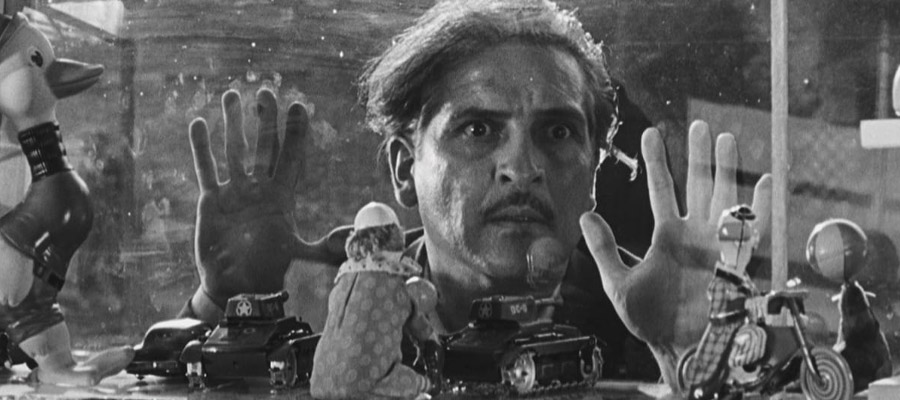
Similar parallels are found in The Man Who Left His Will on Film (1970), a gonzo satirisation of the youth revolutionary movement that acts as both a fierce polemic against the abuse and indignities inflicted by male revolutionaries on women and an open-ended contemplation on how film functions as an interface between reality and the creative self. At the critical point where those two ideas finally clash, the entire world seems to flip on its head—soundless, airless. Here we see Ōshima pushing his avant-garde form to its limits.
By contrast, Boy (1969) takes a more traditional social realist route when dealing with its plucked-from-the-headlines premise: a young child forced into a long-running series of scams by his abusive parents. And yet this is far from a traditional social realist drama, finding strange moments of melancholy amongst the misery; the sequence in which the boy lingers by the shore, having briefly escaped from his family, isolated in the dark but lit by a piercing key light, is deeply moving.
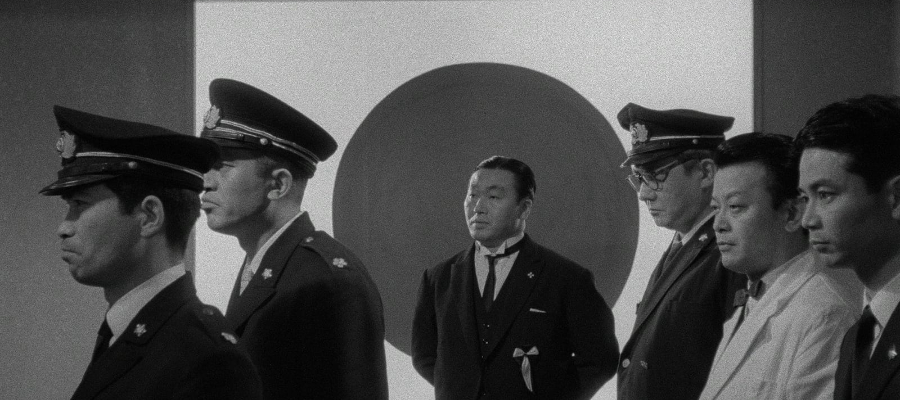
The highlight of this collection, however, is The Ceremony (1971), a film that picks at many of Ōshima's preoccupations—the rigid authoritarian underpinnings of upper crust Japanese society, and the impacts of decades of national repression—while exploring the decline of the once prestigious Sakurada clan, as told through a series of different ceremonies (funerals, graduations, weddings). Each of these ceremonies is shot in static wides with deep focus, Ōshima highlighting the negative space between the family with his slow push-ins and charred palette. In some ways, it forms a companion piece with the final film in the collection, Dear Summer Sister—a story that at the surface initially seems lighthearted and soft-edged, but eventually uncovers years of familial neglect.
Finding such binding threads is what such collections are ultimately all about. A chance to connect ideas across a larger body of work that might otherwise go unmissed—especially in a career as varied as Ōshima's. Assembled here in new restorations, this odyssey of Ōshima's work during the Japanese New Wave through to the last film he released before In the Realm of the Senses is a must for anyone who still holds out hope that a truly radical cinema may emerge again.
Special Features
- Audio commentaries by Samm Deighan on Death by Hanging, Tony Rayns on Diary of a Shinjuku Thief, and select-scene commentary by Jasper Sharp on The Ceremony
- Introductions and appreciations of the films by film historians and scholars Luk Van Haute, Jennifer Coates, Rie Tsukinaga, and filmmaker Yang Yong-hi (2025, 13, 19, 23 and 21 mins)
- After the Tokyo War – a new visual essay by scholar Julian Ross on the complex network of influences on The Man Who Left His Will on Film (2025, 17 mins)
- Archival interviews with Oshima (1986 & 1995, 4 and 7 mins)
- Interviews with actors Tadanori Yokoo and Kazuo Goto (2025, 19 and 20 mins)
- Interview with critic and author Junichi Konuma on composer Toru Takemitsu (2025, 22 mins)
- Extensive interview with critic Tony Rayns on Oshima's life and career (2025, 46 mins)
- Yunbogi's Diary – Oshima's short film about street children in Seoul (1965, 25 mins)
- 100 Years of Japanese Cinema – Oshima's documentary celebrating the centenary of cinema (1995, 52 mins)
- Japanese Cinema: New Territories – a documentary by Hubert Niogret on the Japanese cinema of rebellion and renewal, charting the emergence of independent filmmakers of the 1960s to the 1990s featuring interviews with Oshima, Kiju Yoshida, Shohei Imamura and others (2011, 52 mins)
- Reversible sleeves featuring original and new artwork based on designs by distributor ATG's magazines
- Limited edition 160-page book featuring new writing by Rea Amit, Espen Bale, archival articles by Donald Richie and Alexander Jacoby, plus writing by and interviews with Oshima
- Limited Edition of 5000 copies, presented in a rigid box with full-height Scanavo cases and removable OBI strip leaving packaging free of certificates and markings
Radical Japan: Cinema and State is now available in the UK courtesy of Radiance.
Podcast