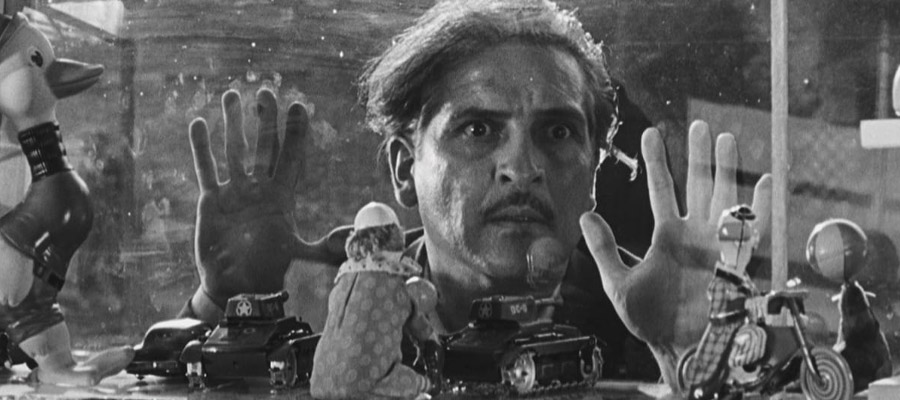
Luis Buñuel may have made more than half of his films in Mexico, but it's the middle era of his considerable career that is often overlooked. More eye-catching is his early work with European surrealists, including co-writing with Salvador Dalí, or the later years that saw films like Belle de Jour win international acclaim. But it was while working in North America between the mid-1940s and mid-1950s that the director honed his storytelling with melodramas incorporating more than a dash of surrealism. Criterion's 4K restoration of Él provides the perfect chance to reappraise the underrated era that helped shape the director's later career.
Released in 1953, Él is an adaptation of Mercedes Pinto Armas's novel Him, depicting what the film's alternative US title calls This Strange Passion. It's a striking, sometimes breathtakingly bold movie, which tackles head-on the complex idea of jealousy and control in the marriage of a successful Mexican businessman and his young wife. It wastes little time burrowing into the man's obsessive personality, but it's the attention Buñuel pays to conjuring suspense and unpredictability that lingers long after the credits.
It starts and ends with religion. At a footwashing ceremony, the successful, wealthy Francisco (Arturo de Córdova) first sees Gloria (Delia Garcés) and instantly becomes besotted. He pursues her, winning her hand from her fiancé and his engineer acquaintance, Raul (Luis Beristán). Leaping forward in time, Raul encounters a disturbed Gloria, who recounts the way her marriage has been ravaged by paranoia since their wedding night. While Francisco cultivates the outward appearance of a pillar of the community, we see how harmless incidents send him flying into fits of jealous rage and tighten his grip on his wife's every move. Gloria, meanwhile, is apparently powerless against Francisco's untouchable public persona.
A 30-minute interview with Guillermo Del Toro in this edition's fairly impressive set of mostly archival special features finds the Mexican director describing Él as Buñuel's Hitchcock (and Marnie as Hitchcock's Buñuel). The links to Hitchcock's Vertigo (released five years later)—from a chilling belltower scene to the breakdown of its central character are clear to see—but it's extraordinary focus and strong visuals that really shape Él‘s legacy.
With a bold structure that adopts a flashback narrated by Gloria for half its runtime, Buñuel commits to taking us into Francisco's mind. There is, though, little sense of an unreliable witness as we watch Gloria repeatedly fail to reassure her husband as he wields carefully constructed power. When seeking the help of her mother or a local priest, Gloria always finds her husband one step ahead. Even at the end, when Francisco's armour seems shattered, his friend Father Velasco (Carlos Martínez Baena) sticks up for him. There is then a sweeping sense of inevitability to this story, all the way to the tell-tale mannerisms of the final shot.
The balance of the marriage rests on the veneer of Francisco's perfect life, which allows Buñuel to poke into contemporary society and religion as he deftly weaves surreal elements into disconcerting scenes. During the climax, we follow Francisco back to the chapel where he first met Gloria, now imagining the congregation laughing at him. But it's in the more suggestive scenes that Él really captivates.
Within the walls of what looks like a fortress on the outside, the film's flashback catches up with the present, where Francisco's actions continue to shock—from his blunt use of a gun to the deeply unsettling hint of what he might do with a threaded needle.
Buñuel ensures he exposes Fransico's arrested development as much as his increasing menace and violence. At one point, the master of the house breaks down like a child to his housekeeper (who, in an earlier scene, revealed the dusty rooms hidden from sight in Francisco's impressive house). In what's an unfortunately timeless tale in so many ways, there's as much for audiences to see in Francisco's character and society's response to him today as there was in the 1950s.
Back to that strain of Hitchcock—Él is a masterclass of suspense. One particularly chilling moment takes place in a packed restaurant during their honeymoon. At the table, a charming Francisco asks his new wife what she thinks is the worst thing about him. It's not the only time the audience is left on the edge of their seat during a film where Hitchcock's famous metaphorical bomb isn't under the table.
4K Ultra HD Blu-ray Special Features
- New 4K digital restoration, supervised by photographer Gabriel Figueroa Flores, director of photography Gabriel Figueroa's son, with uncompressed monaural soundtrack
- One 4K UHD disc of the film and one Blu-ray with the film and special features
- New video essay on director Luis Buñuel by scholar Jordi Xifra
- Appreciation by filmmaker Guillermo del Toro
- Interview with Buñuel from 1981 by writer Jean-Claude Carrière, a longtime collaborator of the director's
- Panel discussion from 2009, moderated by filmmaker José Luis Garci
- Trailer
- New English subtitle translation
- PLUS: An essay by critic Fernanda Solórzano and an interview with Buñuel by critics José de la Colina and Tomás Pérez Turrent
Él is available as part of the Criterion Collection now.
Podcast