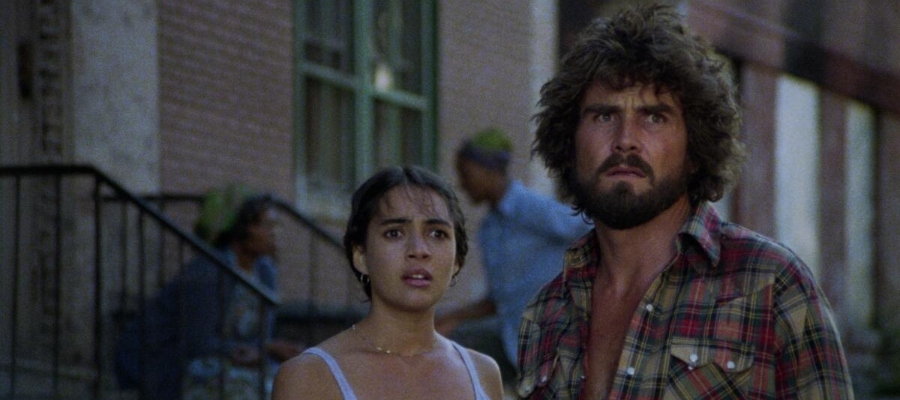

I Swear, the surprising smash hit of the year, tells the story of John Davidson, a campaigner for Tourette's syndrome, famous for the television documentaries following his life and his condition – John's Not Mad (1989), The Boy Can't Help It (2002), and Tourettes: I Swear I Can't Help It (2009). Topping the UK box office and still running in cinemas a month after its release, the film has outlasted Hollywood blockbusters such as Tron: Ares and Springsteen: Deliver Me From Nowhere, proving just how popular it has been nationwide.
Releasing on digital platforms this week, the film's director, Kirk Jones, sat down with FILMHOUNDS to discuss I Swear, John Davidson, and the importance of understanding in the modern world.
First of all, congratulations on the film. I was quite blown away by it, and the reception to it has just been incredible.
Aw, that's amazing. I've had some lovely notes from people, and I've had notes from people who have seen it recently. Like, it's been out for five weeks now, and they've said the cinema was half full and people have been responding really well. I had another one from someone who said there was a standing ovation in a regular screening. Like, it wasn't a festival. There was no reason. No one was there, none of the filmmakers. So yeah, been hearing nice things from people seeing it in cinemas.
I also wanted to stand up and clap when I saw it, and I am sure plenty of others felt the same. I was wondering, how was it that you first became aware of John Davidson? Was it through your attachment to the film, or did the film come about through your own knowledge of his story?
It all started with me in 1989. I saw a film called John's Not Mad and that showed a fifteen-year-old John Davidson who was just coming to terms with the fact that he was developing Tourette's syndrome. I just remember it as being a really powerful documentary of its time, and a very brave one as well. You know, in 1989, people just didn't swear on TV, or, if they did, it was maybe eleven o'clock at night in a gangster movie or something. It was very unusual, very kinda groundbreaking, as was the condition. I didn't really know what Tourette's was; no one really knew what it was. Obviously, I wasn't a writer or a director then; I was just a kid. I was probably then working in London, driving a van around for a film company, making tea and coffee. You know, it wasn't on my radar that I was gonna be a filmmaker, but I do remember thinking, “If ever I did make a film, I think that would make a really good film, it's a good story.” Then I remember seeing him on another documentary when he was in his twenties, and one of the key things there was he said something like, “All I wanna do is just find a partner. I want a girlfriend. But how's that gonna work when I just go up to girls and I spit in their face.” The level of anxiety that we all feel and we all feel when we're growing up about approaching people who we're attracted to or even just speaking to someone you're attracted to. I just thought, wow, imagine how complex it is when you're likely to end up spitting in their face. So that was another one.
Then, I realised that he was in his thirties, that he'd got a job in the community centre, that he was trying to bring people together, and rally people, and inspire people, and support them. Then, most recently, I remember seeing that he had got an MBE from the Queen, maybe six years ago or so. So it was very present, always, in my head. Then, about two and a half, three years ago, I sat down and thought, “Well, what am I gonna do for my next film?” I went back and watched all the documentaries, contacted John, and went to see him. We got on really well. He told me all of his worries and concerns about a film because, I think, the Tourette's community over the years has kinda been… You know, they're used to being teased and laughed at and even kind of tricked, you know. They go on a radio show or TV show, and what people really want is for them to swear so that everyone can laugh at them, because it was a weird thing. So he talked to me about all that history, and it was at that point that I said, “Okay, I'm gonna make you an executive producer on the film,” and he said, “Well, what does that mean?,” of course, because everyone would say that, even I would say that. But I said, “It means that you'll have a voice, that I will show you every page of the script, and you tell me if you are worried or concerned about anything. I'll consult with you all the way through. If you're not happy, we'll change something.” That was really the beginning of the process, so I didn't approach anyone; I wasn't commissioned to write the script. You know, I've been doing this long enough now to know that if you can afford to not take any money from anyone to write the script, then it's yours, and you still have creative control over it. So, I didn't take any money from anyone, and I just spent… probably about six months, but once I got going, I think the writing period was as short as about six weeks to write the script.
Oh wow. Knowing how present he was throughout your life through those documentaries, and then knowing how involved he was in the actual filmmaking process as well, how important was it to you and to John to have moments in the film where we laugh with him rather than at him?
It was really, really important to me, for a number of reasons. First of all, I thought I could see it, even in the documentaries. I could even see John laughing at himself at the strange things he would say. When I met with him, I basically said, “Look, if I said that I could identify a level of humour in the condition, would that upset you, would it embarrass you, would it anger you?” and he said, “Absolutely not,” and then he said something that I never forgot, and probably inspired me to make the whole film. He said, “My life has been the most tragic, and the most hilarious, all at the same time.” As a filmmaker and a writer, I thought, okay, alright, that'll do. Off we go, let's make a start on this. But it's true. When I look at it now, you know, people say that some of the scenes are upsetting because they become so emotionally engaged with John, but they then say thank you for following up with a laugh or a smile or some humour, to kinda balance the emotion. I love doing that. I've been doing that, or I've been trying to do it in pretty much all of my films since I started. I just love that combination of humour and emotion. I think it's why some people, especially with this film, are saying it's like a rollercoaster. Because you're on a high, then there's a big low, and then it brings you back up again. I think a good example of that is where John's trying to get the job, and he's got, what we ended up calling, the interview from hell. He says he's a paedophile, he's shouting out, he calls Tommy a wrinkly old bastard.
He punches his dog.
And punches his dog! So, at the end of the scene, I hear the audience chuckling and I see them smiling. They know John is that close to success; they know he's that close, especially when he makes the cup of tea – even after he spat in it, even after he says he uses spunk for milk – Tommy has a really genuine reaction. He goes, “That might be the best cup of tea anyone's made me in all of these interviews,” and we think, “At last, John, at last you've done something, you've got it, you've got the job,” and then he punches the dog. That's John's life! No matter how hard he worked or how well he was doing, there was always something that let him down through the Tourette's. Tourette's is incredibly spiteful, I think. It is almost like another voice that works out the most upsetting thing you could possibly say, and it will make you say it.
So when I first met John, I travelled up to Scotland. He was obviously a bit nervous; he didn't know me, anxiety was high, which means that ticks are usually very high, so he opened the door, and I said, “Should I take my shoes off?” and he said, “Let's have sex,” and I said, “Shall I take my shoes off first?” But you know, I wanted to make a joke of it. He said, “Oh no, no, that was just a tick,” and he taught me my first lesson, which is, ignore the ticks but not the person. The ticks are not the person. Sometimes they're inspired by something that they see. But in general, when John said “Let's have sex,” that isn't locked away in his head. He wasn't actually thinking that that's what he wanted to do, and he couldn't hold it in, and he just had to say it. It's just the Tourette's trying to think of the most embarrassing thing he could possibly say. Sometimes that's homophobic, it's racist, it's sexist. It changes over time. So, in the '80s, with the overwhelming concerns of AIDS, it was all about homosexuality; it was all about AIDS. He was walking around saying, “I'm HIV positive.” Then there was a period, you remember with George Floyd in America, then it was Black Lives Matter, so the Tourette's just knows and it walks down the street, he walks down the street shouting racist slurs. Then you move into the transgender movement and the MeToo movement. Whatever is out there in the world at that time, that his Tourette's knows will really offend, really make people wanna punch him in the mouth or shout at him or scream at him or ring the police, that is where the Tourette's goes, that is what it shouts out. It's an extraordinary condition.
I think you did a fantastic job throughout the film, balancing the more serious moments with the humour. They play really well off each other in terms of heightening both – the funnier moments are funnier because they've just been followed by a dramatic moment, and vice versa.
Exactly.
Robert Aramayo is unrecognisable in this film as John. How exactly did he come on to the project?
So, we had a casting director called Lauren Evans, and she said to me, “There's someone you really need to look at. He's called Robert Aramayo.” I had not heard of him, and I wasn't aware of his work. There were other people that, of course, she talked about at the same time, but when I saw Rob, I think one of the first things I saw was Behind Her Eyes, which was something that he did, I think, for TV. Funny enough, he played someone that was Scottish. I just had a feeling about him, and I decided that I wanted to meet him over Zoom, which we did, and then we met in person. The thing that amazes me now, I can't quite believe that I did this, but I offered him the part without asking him to audition. I just had faith in him and I could see that he would just throw himself into the project one hundred percent, which he did. I think he spent three months in Galashiels; he was hanging out with John, he was doing the washing up, he was doing the gardening, going to the supermarket, speaking to people who had Tourette's every night, not just John, and reading as much as he could. He was feeding me bits of information, which I was then trying to get into the script. I just trusted him. I don't know, that instinct kind of paid off, but it could've been a disaster. It just felt like the right thing to do.
Terrific instincts. Thankfully, they paid off. I was curious, with John's ticks throughout the film, how scripted or improvised were those?
Well, initially, I had to write ticks because I had to write a script. Sometimes those ticks were very relevant so when he says, “Fuck the Queen,” you know, if he'd shouted out “Egg on toast” or just some weird tick, it wouldn't have really meant anything and it wouldn't have been as relevant or as funny so something like that is a written tick and there's no getting away from it. I also wrote every other tick that was in the script, but one of Rob's first questions was, “You don't expect me to tick exactly what you've written in exactly that place, do you?” Because that isn't what Tourette's is, and I thought “That is a very, very smart observation,” and I said “No, you're absolutely right, it should feel like it's just come out of nowhere,” which is what Tourette's is.
Also, one of the advantages of doing it Rob's way was that it meant the actor that he was playing against was always on their toes; they didn't know what was coming. So Rob did a few things. Often, he would do what I'd scripted. We'd just do that, get that out the way, so we had that in case we needed it. Then he would start to introduce some of his own ticks, then he would start to introduce them in different places with different timings and what that meant was, it felt more authentic. You know, if you do five takes, and someone ticks exactly the same thing in exactly the right place, then the actor they're playing against knows exactly what's coming. Although they're great and they act and they react, it's always scripted, and they always know it's coming, and of course, the thing with Tourette's is it's unpredictable. It's completely and totally unpredictable. So Rob would just start to play around, introduce different ticks at different times. Some of the ticks he had picked up from people he'd been speaking to. So he might have spoken to someone on a Zoom call one evening for an hour and talked to them about their Tourette's, and they'd be ticking on the Zoom call, and he would write down some of his favourite ticks. When he's waiting to go into Dotties for the first time, he says, “Fuck you in particular, fuck you in particular, fuck you in particular.” I'm thinking like “Where does that come from, why is he saying that?,” and I'm pretty sure with that one, he said that he'd heard someone else say it on a Zoom call. So there were all sorts of things that he was noting down and collecting, so that if he struggled to find anything, he would go to his little notes and pick out one that was a real tick that had come from someone else at another time, but which felt very authentic.
I thought Robert was absolutely incredible. How did John feel seeing Robert play him? What was his reaction to seeing his own life on screen?
I think a lot of it was to do with that first meeting that we had. I was probably there for about three days, and, you know, I had to be vetted by Dottie, and we had afternoon tea together and we chatted and chatted. I think after those three days – well, maybe even after one day – he started to realise that he could trust me. You know, who knows who you can trust in the modern world, but I think his instinct was that I sort of understood and that I wanted to do a good job, and I wanted him to be proud of the work. So that was stage one, and then I started showing him pages that I was writing, and he seemed very happy with those. Then he met Rob. I took Rob up to meet him, and we hung out for a couple of days. And then Rob was given the part, and then Rob started spending more time with him, which reassured him. Then, when he watched the film, he was just completely blown away. I think it was so much better, the film and the way in which the story was told and, in particular, Rob's performance, so much better than John had ever imagined it could possibly be. There was just lots of hugs and tears from him and Dottie and Chris, and Murray and they were just thrilled. They were really thrilled that John had not been taken advantage of this time. That we had done our best to try and portray him, honestly, without making fun, without being too cheesy, without being too sentimental. So, John had a really great experience with the whole thing.
One of my favourite things about the film is the way in which empathy plays a role in his life and his ticks. Whenever he is with Dottie or Tommy, he still ticks, but a lot less. It's a beautiful way of showing how, while Tourette's will always play a role in his life, one of the biggest ways to help it is through people understanding and being empathetic. The film is, obviously, creating awareness around Tourette's, but what does it mean to you to put this film out and show how important empathy is to the people who see it?
I mean, everything, basically, it is everything for me. What I realised quite quickly was, I thought we'd made a film about Tourette's, but actually we'd made a film about empathy, about understanding, and we had made a film which has touched a huge community, not just in this country but, I think, around the world, who live with a neurodiverse condition. So, it's not just Tourette's. People are approaching me at screenings and shaking my hand and hugging me and sending me messages. People who have autism, people who have OCD, people who have ADHD, are all saying, “Thank you for making a film which highlights a neurodiverse condition.” So, I knew pretty much that the whole of the Tourette's community would be interested. I hoped that they would approve. I hoped that they would be inspired by it and that they would think that it might make a change. Actually, I know that has happened. Someone sent me a link the other day to show that Tourette's was raised in the Scottish parliament for the first time in twenty-seven years. Someone stood up and talked about Tourette's and that people with Tourette's needed to be supported more and then they said “I went to see the excellent film recently, I Swear” and I'd already been sent another link from someone from the Welsh parliament who were discussing ways in which people with Tourette's can be more quickly diagnosed, supported, helped and understood, so that was pretty amazing as well. I just think that whole neurodiverse world, of which, for some reason, and I'm not sure why, maybe just because we have a better understanding now, there just seem to be an awful lot of people out there, and a lot of my friends' children have some level of a neurodiverse condition.
My friend saw a preview of the film, and he was incredibly touched by it. He is autistic and has OCD as well. I'm neurodiverse as well, and I found it a really incredible, touching and beautiful film. That's all the questions I have, so thank you for taking the time to talk to me. I really appreciate it.
That's brilliant. Just on that last note, I'm hoping that people who have a neurodiverse condition, or live with it, kind of feel a little bit more empowered. A little bit cooler. Because all of these conditions just make us more interesting people. I met someone who's autistic recently – unbelievable with numbers and maths, and figures. Someone else might be more creative. I know people in the film industry who are neurodiverse, and they are extraordinary, visionary people, because they think more in pictures. They were useless at school with English and maths, but they're more visual. I think it's just all about understanding.
I Swear is available on digital platforms now.
Podcast