
Hell's Angels is a war epic onscreen and off. The stunning visuals captured on film came at the cost of one of the most notorious shoots in history. A lot, including lives, were put on the line for Howard Hughes to capture this extraordinary story of two brothers in wartime.
Ahead of the First World War, two very different brothers, the dependable Roy (James Hall) and womaniser Monte (Ben Lyon), holiday in Munich with their German friend Karl (John Darrow). After Monte runs away from a duel against a jilted husband (and German officer), Roy steps in, escaping with an arm wound. Still, the three soon find themselves back at Oxford University, where world events intervene. Roy and Monte enlist with the RAF, while Karl joins the German military, only to die in a Zeppelin raid on London that the brothers barely escape from. While Roy finds himself let down by the woman he dotes on and Monte struggles with the purpose of war, the siblings undertake a daring raid on a German munitions factory, only to be captured by the enemy. Bands of brothers, real and metaphorical, have formed the heart of many war films. Here, the loyalty between two very different siblings underpins the extraordinary extended sections of aerial combat.
Hell's Angels was ambitious before it became clear it was being made at one of the major pivot points of Hollywood history. Hughes had always intended to shoot the aerial footage, but had already barrelled through three dramatic directors before Alan Crosland's The Jazz Singer (1927) ushered in the talkie era. Hughes decided his film had to have dialogue, hiring the fresh-to-America James Whale to direct it. The shift meant a change of lead actress—giving Jean Harlow her breakout role—and nearly a century on, it leaves us with a film of fascinating oddities.
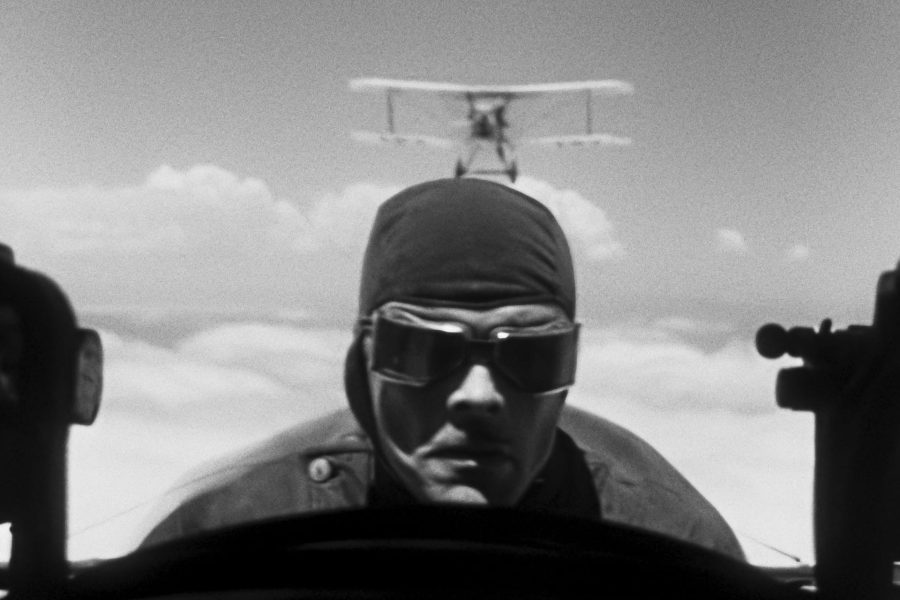
The action scenes are jaw-dropping, with Hughes mostly using real planes and hiring First World War pilots for thrilling and awe-inspiring shots. Impressive model work is mainly reserved for the Zeppelin—a real one being an investment too far even for Hughes. It's not just the shots of the planes in motion, soaring and diving, or the cockpit shots of Roy (pilot) and Monte (gunner) and their final act foe, von Richthofen (the Red Baron) that vividly capture the frenzy. The close-ups of bullet holes peppering the metal fuselages are just as astonishing.
Hughes' focus was clearly on capturing footage that had never been seen before, at a high cost. It can't be forgotten that his singular vision may be spectacular, but it cost the lives of three stunt pilots and a mechanic during its three-year production. Hughes was almost added to that number when he ignored the warnings from his lead stunt pilot to undertake an ambitious dive in the final act himself, ending up with a fractured skull and facial reconstruction.
What he captured on screen is all the more vivid due to an extraordinary use of colour. Hell's Angels is predominantly monochrome, bar one notable party sequence shot in Technicolour. Most of the combat, however, is framed in deep blocks of colour. Fire is often colourised on its own, appearing as a searing orange wall, flooding the screen at the Zeppelin's demise to the point of surrealism.
Despite the shift to dialogue, vestiges of the silent era are felt in the occasional florid title card. Given its 130-minute duration, one can only imagine how long a silent version might have been. But the result then is an impressive sense of splendour as much as the feeling Hell's Angels captures a moment of time, either side of its intermission.
Given Hell's Angels' preoccupation with air combat, it's no surprise the continuity between scenes is loose, and the accents of the two British brothers are unapologetically transatlantic. Both of those are more forgivable given Hell's Angels' production history, and they don't stop the wallop of the pay-off, as chance and fate come back to test the brothers' loyalty, which far exceeds the dramatic build-up.
Now captured in ultra-high definition in this painstaking restoration, which gratifyingly includes specks and grain, the biggest draw, however, remains the impressive sound design and the costly action captured at a very specific period of Hollywood history.
4K Ultra HD Special Edition Features
- New 4K digital restoration of the Magnascope road-show version of the film, with uncompressed monaural soundtrack
- One 4K UHD disc of the film and one Blu-ray with the film and special features
- New interview with Robert Legato, the visual-effects supervisor for the Howard Hughes biopic The Aviator, on the groundbreaking aerial visuals of Hell's Angels
- New interview with critic Farran Smith Nehme about actor Jean Harlow
- Outtakes from the film, with commentary by Harlow biographer David Stenn
- English subtitles for the deaf and hard of hearing
- An essay by author and journalist Fred Kaplan
Hell's Angels is available as part of the Criterion Collection now.
Podcast