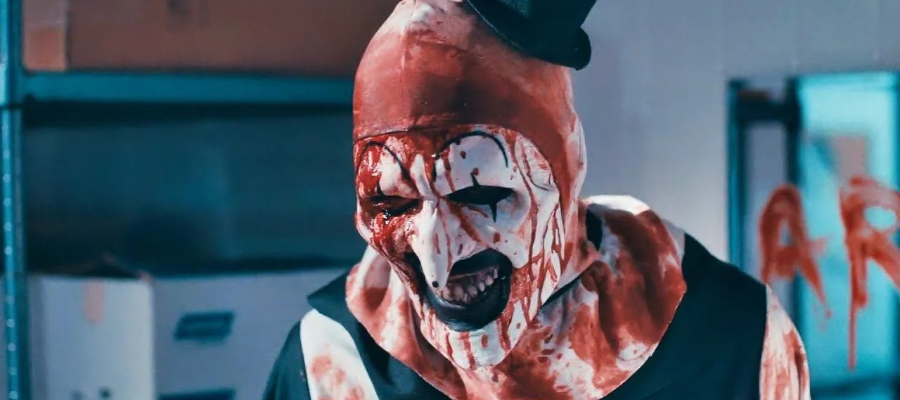
Love them or hate them, the Terrifier films evoke big reactions from viewers. Some love the silliness of the central villain, Art the Clown (David Howard Thornton), and the way he's bringing gore back to horror. Others feel that these films go too far, and that the violence goes too far. It has become a popular criticism to say the Terrifier films are misogynistic. They are slasher films – horror films with a central killer, focused on a final girl who survives, with a high body count and violent kills. One could argue that slasher films are always inherently misogynistic, that it's almost always a male killer chasing women and girls, who are often sexualized before they are killed. However, the Terrifier films have been given special attention, and the claims of misogyny have been especially targeted at these films. Even fans of other slashers draw a line at Terrifier, saying the misogyny is too much. However, the Terrifier films are not any more misogynistic than other slashers. The plot lines, the characters, and even the kills are along the lines of what we can expect from other slasher films, if not less misogynist than some of our ‘80s favorites.
The first film, Terrifier (2016), is built on a foundational assumption that women have to fear men for their own safety, which was topical when it was released in 2016, with the political climate in the US, and is still topical today. Right on the cusp of #MeToo, Terrifier was released into a world in which women were about to speak up loudly for their own safety. Terrifier takes a non-misogynist stance centering the violence committed by men on women.
Dawn (Catherine Corcoran) and Tara (Jenna Kanell) are out on their own on Halloween night, in sexy costumes. This is a typical situation in which women have to be hyper-vigilant to the actions of men. Before they or the audience know anything about Art the Clown, he seems to be a dangerous man, focused on, at the very least, harassing Dawn and Tara. The pizza shop manager, a man, notices and takes action. As women speak up about rape culture, we implore men to notice when we need help, and not just be a bystander, but to step in if they can. He knows women should be able to come into his restaurant and relax, free from harassment. He does not blame them. The framing of the premise of the first film is that the women don't deserve to be tortured and killed by Art for simply existing, and they shouldn't have to be on alert for the actions of men.
Unfavorable reviews of Terrifier call Tara and Dawn “dumb and bitchy,” which feels more misogynistic than the movie portrays them. While they might make choices one viewer wouldn't make, another viewer might make similar choices – they are out on Halloween, drinking and getting pizza, trying to avoid driving drunk, calling for help. Dawn taking pictures with Art is not a safe choice, but he targeted them before that behavior, and who among us doesn't have a friend who would do exactly that? The portrayal of Dawn and Tara is a refreshing view of women having fun on Halloween and being friends, nothing overtly misogynistic about it.
The characters in each Terrifier movie offer strong representations of women with agency and intelligence, who lean on friendship and family for strength. Women are portrayed as empowered and persistent, and in fact, women are necessary for beating Art the Clown. The diversity of female characters in the Terrifier films show a thoughtfulness that isn't always present in slasher films' characters. The best example is the main character of the second and third film, Sienna Shaw (Lauren LaVera).
Sienna is a complex character. In the nearly five hours we have spent with her across two films, we have seen many sides of her. She's a thoughtful friend, a caring sister, and a devoted cousin. She fights hard for herself and others, and she takes care of herself with medication and therapy. She is not a perfect person, but she is a more realistic final girl than many who share that title, and it's refreshing to see. She is not sexualized, not because she needs to be virginal, but because she doesn't have the time or mental energy to worry about sex. It's not something we see her consider at all. She and her magic sword are the only hope to stop whatever Art the Clown may be.
Often, in slashers that came before, the final girls' friends are depicted as stupid, slutty, irresponsible, or otherwise less deserving of survival than the final girl. Sienna's friends are granted more complex and human characterization. While Brooke (Kailey Hyman) is irreverent and sexual, she is a concerned friend, and wants to help Sienna feel better. She goes about it the wrong way, by sneaking drugs into her drink, but it's a genuine, albeit misguided, effort to be a good friend. When Sienna doesn't come back from the abandoned amusement park, Brooke goes to look for her. It's a believable look at a high school friendship where one friend is frustrated, feeling like she lost her friend to grief, but still wanting to be there for her. The other friend in their trio, Allie (Casey Hartnett), sticks by Sienna when Sienna seems to be having a rough time. She gently suggests to Sienna that maybe things aren't as bad as she thinks. We don't see as much of Allie before she dies (horribly), but what we do see is another good friend who wants Sienna to feel better, and not abandon her. Nothing about Sienna's friends is depicted in a misogynistic way, as other final girl friend groups have been depicted.
Many of the allegations of misogyny stem from Dawn's kill in the first film. In an unforgettable scene, Dawn is hung upside down in only her underwear, and sawed in half from her crotch to her head with a hacksaw. Whether you are a gorehound who cheered for a creative kill, or a viewer who cringed and looked away, the impact is impressive. But killing a naked woman starting with her crotch led to cries of misogyny in the first film, which were later applied to the whole franchise. But to understand this kill, you must understand the psychology of Art the Clown. He tortures, physically and psychologically, for his own amusement. The way he kills Dawn is to strike maximum fear and horror into Tara, which amuses Art. He does not find the kill sexually interesting, and the film itself doesn't shoot the kill in a titillating way. Other than the existence of a woman's naked body, there is nothing sexual or sexy about this kill. It is incorrect to call this kill sexual simply because a woman's body is centered.
As for the rest of the kills in the franchise, they continue to uphold the idea that Art operates for his own amusement. The jack-o-lantern head in the pizza shop, Allie's horribly creative ordeal, “just the tip” for Brooke's boyfriend, Santa and the liquid nitrogen. When Art is done playing, he's happy to quickly produce a gun and shoot his victims, and walk away.
Some viewers speculate that the chainsaw kill of Cole (Mason Mecartea) in the third film is a response to Dawn's kill. Cole is bare naked from the shower, and chainsawed in half from the bottom up, just as Dawn was. Cole's kill is much bloodier, because of the chainsaw rather than a hacksaw, and his steaming entrails ooze out of his body. The filmmakers may have decided to include that kill as an olive branch to the misogynist claims. If Dawn's murder was misogynistic, killing a man in a similar way wouldn't erase that, especially two films later. The misogyny would still exist. However, Cole's murder is more of a testament to Art's style. He kills in whatever way he prefers, regardless of the gender of the victim, and neither he nor the films sexualize the kills. His kills are either practical or for his own amusement, and the gender of his victims never matters to him.
The Terrifier films are slashers. If slashers must be inherently misogynistic, then that must include the Terrifier films. However, if a claim can be made that slashers do not have to be misogynistic, then that can apply to the Terrifier films. Of the three Terrifier films we have so far, nothing in the plot, characters, kills, or filmmaking suggests intentional or unintentional misogyny. The Terrifier films were the center of even more backlash after the director, Damien Leone, said the films “aren't political,” sparking anger in horror fans who know all art is political (including me). Some viewers have taken their disgust for the director and applied it to his films. Still, that doesn't mean the films are misogynistic. If the Terrifier films aren't for everyone, that's ok – they are violent, mean, and hide nothing off-screen. But if you enjoy other slashers, and wouldn't necessarily call them misogynistic, consider if the claims of misogyny in this franchise really hold up under scrutiny.
Podcast